You’re Doing Everything You Can—But It Still Feels Like It’s Not Enough
You’re working with students who struggle to read, write, and fully access grade-level content. You’re differentiating, scaffolding, and supporting—but progress feels inconsistent.
You may be asking:
- How do I reach students who are still at beginning reading levels?
- How do I support multilingual learners without lowering rigor?
- How do I make literacy instruction actually stick?
You are not alone—and more importantly, you are not without a solution.
"What we can improve, as most schools do, is ensuring that systems and strategies are in place to remove barriers to learning. This is where frameworks like A.C.C.E.S.S. become relevant. It is a well-founded, research-driven framework that promotes improved literacy across different subjects while removing systemic and innate barriers faced by students."
-
S. Navarro, Teacher, Assumption IloIlo, Philippines-
A Clear, Structured Path Forward
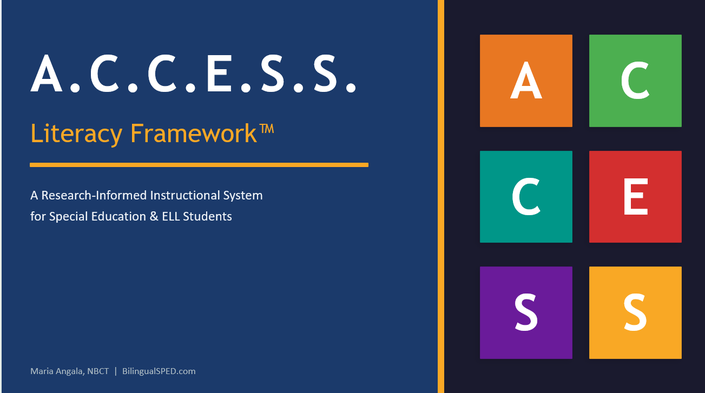
THE A.C.C.E.S.S. Literacy Framework's 6 COMPONENTS:
A — Activate Background Knowledge (orange) Connect new learning to prior knowledge and experiences. The research is clear — activating schema before instruction is the highest-effect instructional strategy globally (Marzano, 2004). When students see this on the wall, they know what's coming before the lesson even starts.
C — Clarify Language & Vocabulary (green) Pre-teach and reinforce academic language. Tier 2 and Tier 3 vocabulary unlocks content access for ELL students and struggling readers in ways that reading the text twice never will. This component reminds both teacher and student that vocabulary isn't pre-work — it is the work.
C — Chunk Complex Text & Tasks (teal) Break down reading and writing into manageable steps. Cognitive Load Theory (Sweller, 1988) explains exactly why unbroken complex text overwhelms diverse learners — and this component reminds the whole class that chunking isn't simplifying. It's accessing the same rigor through a better door.
E — Engage with Evidence (red) Cite and explain text evidence to support answers. This is the RACE writing strategy made visible — students learn to move past summary into actual evidence-based reasoning. The magnifying glass icon is deliberate: good readers look for evidence, they don't wait for it to appear.
S — Support with Scaffolds (purple) Use sentence frames, guides, and visuals. Scaffolds are bridges, not crutches — and having this on the wall is a daily reminder that supporting diverse learners isn't lowering expectations. It's making the path to those expectations walkable.
S — Synthesize & Show Understanding (gold) Demonstrate learning through writing and discussion. Learning that can't be expressed hasn't been internalized. This final component closes the loop — and the speech bubble icon signals to students that their voice, written or spoken, is the evidence of their learning.


Level 1: Classroom Implementation Pathway
(Ongoing since April 2026)
The first level focuses on classroom implementation. This level, called Certified A.C.C.E.S.S. Educator, trains teachers to use the framework with their own students. Participants complete modules on the framework, demonstrate lesson implementation, and submit a short reflection or portfolio. This can be delivered as an online course with optional live sessions.
"Grateful for this experience.
Effective teaching entails teachers being equipped with skills that could help learners be the best they can be."
- P. Velasco, Teacher,
Assumption IloIlo, Philippines-

Level 2: Certified A.C.C.E.S.S. Instructional Leader
(Launch Date: August 2026)
The second level is the Certified A.C.C.E.S.S. Instructional Leader pathway. This tier is for department heads, instructional coaches, or lead teachers. The emphasis shifts from classroom use to supporting other teachers. Participants learn how to guide teams, facilitate collaborative planning, and evaluate implementation of the framework across classrooms.

Level 3: Certified A.C.C.E.S.S. Trainer
(Launch Date: April 2027)
The third level is the most powerful component: Certified A.C.C.E.S.S. Trainer. At this stage, educators are licensed to conduct official workshops in their schools or districts. Trainers receive presentation materials, facilitator guides, slide decks, and workshop protocols. They must demonstrate mastery by delivering a pilot training or submitting a recorded session. Once approved, they can deliver the program locally while crediting the A.C.C.E.S.S. Literacy Framework.

Meet Your Instructor
As a National Board Certified Teacher (NBCT) and Exceptional Needs Specialist, Maria makes her classroom a great place for learning by having a research based instructional model incorporating the use of self-directed learning cycle where her students learn the different 21st Century skills targeted by career standards. Her lessons include more rigor, more technology and more independent practice than ever before. Her goal is to ensure that her students have an explicit and accelerated path to college and career readiness despite their challenges. Every year, more and more students rise to the challenge in her classroom where they are given the right resources, supports, and time to master the skills. She has a consistent track record of student progress where in the past, Maria’s students have demonstrated 4-6 years of reading growth surpassing their yearly reading growth goal of 1.5 years.
Maria is dual certified in Special Education (SPED) & Teaching English to Speakers of Other Languages (TESOL) and on top of being a classroom teacher, Maria is also a Teacher Leader. She has served as an Executive Board Member of her Teacher's Union for 6 years, and in 2019-2020 was with the Chancellor’s Teacher Cabinet. In both capacities, and as a National Board Professional Learning Facilitator, she's been having conversations with policymakers and politicians about the value of National Board Certification to students and teachers, advocating for supports for National Board Candidates and elevating the professional voice of teachers. Maria also helps in making sure that her school district has great teachers in the classrooms every year as a Teacher Selection Ambassador.
If you believe education should be inclusive, innovative, and globally connected, you are invited to be part of that founding cohort. Take a moment to add your name to the community:
A.C.C.E.S.S. Literacy Framework Official Certification Program
A structured, research-informed pathway from classroom practitioner to licensed trainer to institutional excellence.
We are gradually launching the 3 Levels of Certification. For now, we will start with the FREE Introductory Masterclass.